
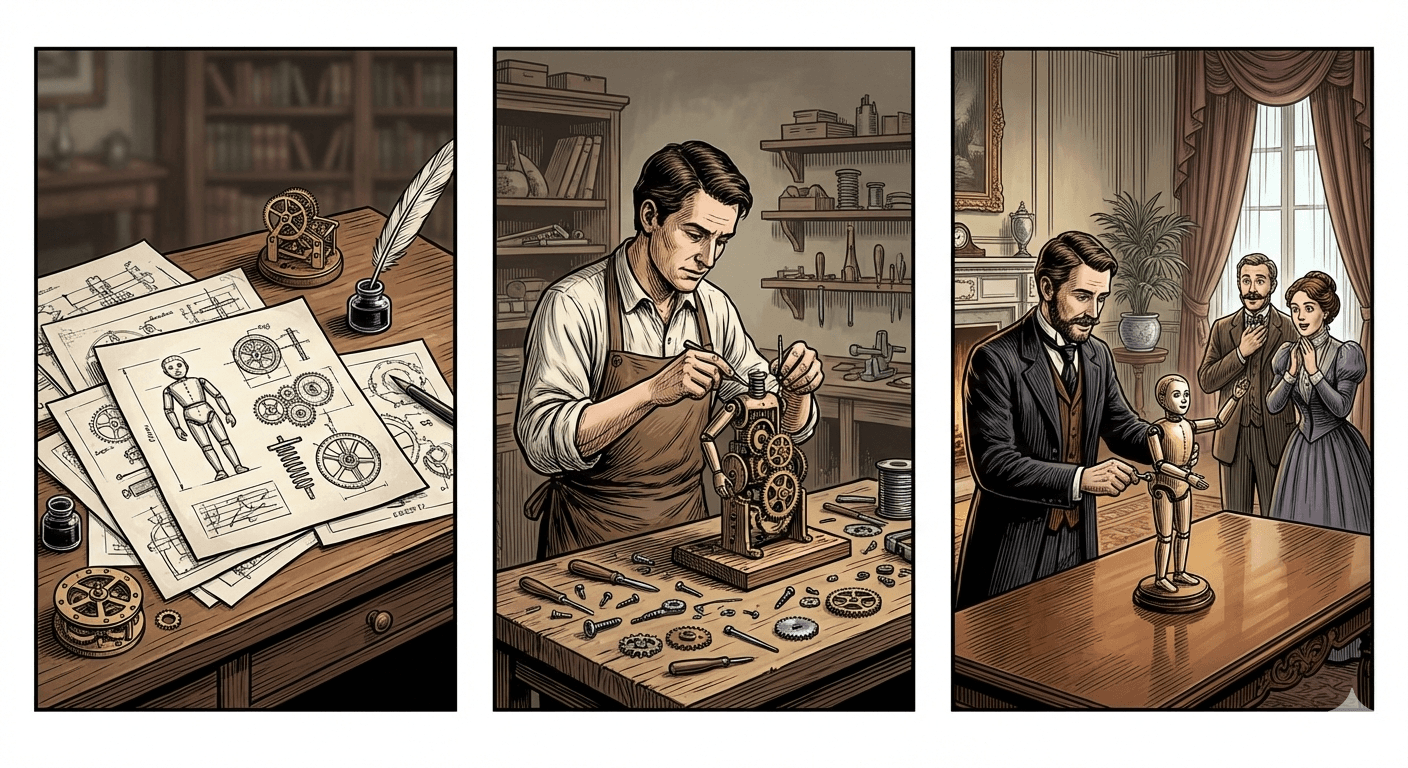
A new device has been placed in the parlor.
Not a clock, not a phonograph, not a novelty for show—
but a modest conversationalist whose entire purpose is simple:
“Talk to my website.”
A visitor arrives, asks a question, and the Chronicle answers in its own voice—grounded in what has already been published, not in whatever the wider world happens to contain.
And, if possible, it answers at near-zero running cost.
The goal
Most modern “chat with your docs” systems are not complicated in concept—
but they become expensive in practice when every question must be paid for, token by token, forever.
So the Parlor Automaton was conceived with three intentions:
-
Local first.
Keep the knowledge base on our side of the wall, searchable without a server-side oracle. -
Grounded answers.
Retrieve relevant text from the Chronicle itself, then answer using that context. -
Cost discipline.
Push as much work as possible into build-time and local search, so runtime costs can approach zero (or at least remain predictable and small).
This is not about chasing a trend. It is about building a system that is economical enough to keep alive.
How it currently works (manual RAG)
At present, the Automaton uses a manual RAG approach:
- Index: a local search index built with MiniSearch
- Retrieve: query → top matches from the site’s content
- Compose: those matches are stitched into a prompt
- Answer: we ask Gemini (free tier) to produce the response
- Ship: the first build is already deployed and usable under the Parlor menu
It is simple. It is pragmatic. And it works well enough to publish.
The imperfections (our current “Errata”)
The first release is real, but not yet refined. A few known issues have already made themselves visible:
-
Messages being cut
Some responses truncate or lose detail when the context payload becomes too large or poorly shaped. -
Rough chunking
If the text is chunked at the wrong boundaries, retrieval brings back fragments that are technically relevant but narratively awkward. -
Index freshness
Right now, indexing is still too manual. If we publish new writing, the Automaton should learn it automatically as part of the build.
In other words: the automaton speaks, but it does not yet keep up with the printing press.
The next mechanical improvements
The roadmap is not glamorous, but it is the kind of work that makes the whole system feel inevitable.
1) Wire indexing into the site build pipeline
When the website builds, the Automaton should automatically:
- discover new posts/pages
- extract clean text (and metadata: title, section, tags, date)
- chunk it intelligently
- rebuild the MiniSearch index
- publish the updated knowledge base alongside the site
No separate ritual. No forgotten step.
2) Improve retrieval quality
A few practical upgrades, in plain language:
- better chunk boundaries (headings, paragraphs, callouts)
- store source references (so answers can cite where they came from)
- reduce duplicate matches
- a small “re-ranking” pass (even a simple heuristic helps)
3) Add guardrails for truncation
To reduce cut-off responses:
- enforce a strict context budget
- summarize retrieved passages when needed
- prefer fewer, higher-quality chunks over many mediocre ones
4) Keep the “cost dial” visible
Even on a free tier, discipline matters.
We want explicit switches like:
- “local only” mode (retrieval + extract, no model call)
- caching common questions
- an optional “bring your own key” path later, if needed
Why this belongs in the Chronicle
Because AI is reducing the cost of producing code—and that changes what matters.
When “writing code” becomes cheaper, the advantage shifts toward:
- understanding the system
- designing constraints
- making tradeoffs explicit
- building feedback loops
- keeping a product maintainable and alive
The Parlor Automaton is not just a chat widget.
It is a small lesson in systems thinking:
- Build-time vs runtime costs
- Local retrieval vs remote dependency
- Accuracy vs speed
- Charm vs reliability
- “It works” vs “It keeps working”
And that, frankly, is the kind of engineering that compounds.
Where to find it
The first build is live.
You can speak to it now under the Parlor menu.
Ask it about the first press. Ask it about lanterns on new ground.
Then watch where it hesitates—that hesitation is the next ticket.
— Diego, Editor